Weapons, Armor and Tactics of the Teutonic Order
The Teutonic Order’s reputation in the Latin West rested, in significant part, on the Order’s battlefield performance in the Baltic theatre. The Order’s battlefield performance was, in turn, the product of a distinctive combination of armament, armour and tactical doctrine. The Order’s armament and armour were, on the whole, conventional Latin armament and armour of the high and late middle ages, but the Order’s tactical doctrine was, in significant part, distinctive — a synthesis of Latin heavy cavalry practice and the specific operational requirements of the Baltic theatre.
The Order’s tactical doctrine was, the most distinctive single feature of the Order’s military practice. The Order’s tactical doctrine was based on the close-order heavy cavalry charge, executed by knight-brothers organised in disciplined tactical units. The Order’s tactical doctrine was, conventional Latin tactical doctrine, but it was executed with a level of discipline and coordination that was, by the standards of the Latin West, very unusual. The Order’s tactical doctrine was, in significant part, the foundation of the Order’s military reputation.
Knight Armament
The armament of the Teutonic knight-brothers was, conventional Latin armament of the thirteenth and fourteenth centuries. The principal weapons were the lance, the sword, the mace, the dagger and, in the late fourteenth and fifteenth centuries, the war-hammer. The Order’s principal weapon, in the tactical sense, was the lance — the long, heavy cavalry lance that was, in the Latin West, the principal weapon of the heavy cavalry charge. The Order’s lance was, on the whole, similar to the lances used by the great feudal armies of France, England and the German lands, but the Order’s lance was, in the tactical sense, used with a level of discipline and coordination that was unusual in the Latin West.
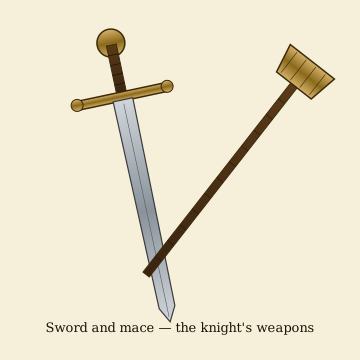
The Order’s secondary weapons — the sword, the mace, the dagger and the war-hammer — were used in the close combat that followed the initial cavalry charge. The Order’s sword was, a conventional knightly sword of the period: a straight, double-edged, cruciform-hilted weapon, designed for both cutting and thrusting. The Order’s mace was a heavy, flanged weapon, designed to crush armour at close quarters. The Order’s dagger was a short, sharp weapon, designed for the close combat that followed a successful cavalry charge. The Order’s war-hammer, in the late fourteenth and fifteenth centuries, was a heavy, single-handed weapon, designed to crush plate armour at close quarters.
The Order’s armament is examined in detail in a separate article on the weapons of the Sword Brothers, who were the Order’s predecessors in the Baltic theatre and whose armament was, in significant part, the foundation of the Order’s own armament.
Armor
The armour of the Teutonic knight-brothers was, throughout the Order’s history, the most expensive component of the Order’s military equipment. The Order’s knight-brothers were, in the early years, equipped with chain mail — the hauberk — supplemented by a helmet, a coif and a shield. The Order’s knight-brothers, in the late thirteenth and fourteenth centuries, transitioned to plate armour, with the great helm, the breastplate, the pauldrons, the vambraces and the greaves. The Order’s knight-brothers, in the fifteenth century, were equipped with the full plate harness of the late medieval period.
The Order’s knight-brothers were, in the operational sense, very heavily armoured. The full plate harness of the fifteenth century weighed, in total, perhaps 30 to 40 kilograms, and the great war-horse — the destrier — was, in addition, equipped with its own armour: the chamfron, the crinet, the peytral and the croupière. The total weight of a fully equipped Teutonic knight and his war-horse was, in the operational sense, very substantial: perhaps 200 to 250 kilograms in total. The Order’s knight-brothers were, in consequence, very heavily protected, but they were also very heavy, very slow, and very expensive to equip.
The cost of the Order’s plate armour was, a substantial financial burden on the Order. The Order’s expenditure on armour was, in the late fourteenth and fifteenth centuries, a very substantial fraction of the Order’s total military expenditure. The Order’s financial difficulties, in the fifteenth century, were, in significant part, the consequence of the Order’s increasing expenditure on expensive plate armour.
The Great Horse
The war-horse of the Teutonic knight — the destrier, or Streitross in the German language of the Order — was, the most important single component of the Order’s tactical system. The destrier was a heavy, powerful horse, bred specifically for war, capable of carrying the weight of a fully equipped knight and capable of delivering a controlled, coordinated charge. The destrier was, in the tactical sense, the foundation of the Order’s heavy cavalry practice.
The Order’s destriers were, in the operational sense, very expensive. A single destrier could cost, in the fifteenth century, the equivalent of several years’ income for a typical knight, and the Order’s expenditure on war-horses was, in the late fourteenth and fifteenth centuries, a very substantial fraction of the Order’s total military expenditure. The Order’s destriers were, in significant part, imported from the great horse-breeding regions of the Latin West: the Spanish andalusian studs, the German marshland studs, the Hungarian and Polish steppe studs.
The destrier was, the most distinctive single component of the Order’s tactical system. The destrier was, in significant part, the reason why the Order’s heavy cavalry was, throughout the Order’s history, a very formidable force. The destrier was, however, also a substantial long-term liability: the destrier was expensive, the destrier was difficult to maintain, and the destrier was, in the operational sense, of limited use in the more demanding operational environments of the Baltic theatre.
Siege Engines
The Order’s principal siege engines were, conventional medieval siege engines of the high and late middle ages. The Order’s principal siege engines were the trebuchet, the mangonel, the ballista and, in the late period, the cannon. The Order’s principal siege tactics were, conventional medieval siege tactics: the construction of approaches, the construction of mines, the construction of breaching batteries, and the close assault.
The Order’s siege warfare capability is examined in detail in a separate article on medieval siege engines. The Order’s principal siege engines were, an important component of the Order’s operational capability, and the Order’s siege warfare was, in significant part, the foundation of the Order’s success in the conquest of Prussia and in the defence of the Order’s Baltic territories.
Tactical Doctrine
The Order’s tactical doctrine was, the most distinctive single feature of the Order’s military practice. The Order’s tactical doctrine was based on the close-order heavy cavalry charge, executed by knight-brothers organised in disciplined tactical units. The Order’s tactical units — the Züge — were, in the operational sense, the building blocks of the Order’s field armies. A Zug was a tactical unit of 50 to 100 knight-brothers, organised in three or four ranks, with the Spitze — the most experienced knight-brothers — in the vanguard.
The Order’s tactical doctrine was, the foundation of the Order’s military reputation. The Order’s tactical doctrine was, in significant part, the reason why the Order’s army was, throughout its history, a small but extremely competent military force. The Order’s tactical doctrine was, in significant part, the reason why the Order was, in the thirteenth and fourteenth centuries, a dominant military power in the Baltic theatre.
The Order’s tactical doctrine was, however, also a substantial long-term liability. The Order’s tactical doctrine was, in significant part, the reason why the Order’s army was, in the fifteenth century, increasingly unable to compete with the larger military organisations of the Polish-Lithuanian union. The Polish-Lithuanian army, in the late fifteenth and early sixteenth centuries, was a much larger and a much more flexible force than the Order’s army, and the Polish-Lithuanian army was, able to defeat the Order’s army in the major field engagements.
The Role of Infantry
The Order’s tactical doctrine was, throughout its history, a doctrine of heavy cavalry. The Order’s principal tactical units — the Züge — were, in the operational sense, heavy cavalry units, and the Order’s principal tactical operation was the heavy cavalry charge. The Order’s infantry, in the tactical sense, was a secondary force, used to support the heavy cavalry in the field and to garrison the Order’s fortresses.
The Order’s principal infantry units were, in the thirteenth and fourteenth centuries, the Prußen — Prussian auxiliaries, recruited from among the Prussian tribes that had been Christianised — and the German settlers. The Order’s principal infantry units, in the fifteenth century, were the Söldner — mercenaries hired for specific campaigns. The Order’s infantry was, in the operational sense, very effective in the defensive — the Order’s fortresses were, throughout the Order’s history, very formidable defensive positions — but the Order’s infantry was, in the offensive, of limited capability.
The Order’s reliance on heavy cavalry was, a substantial tactical liability. The Order’s heavy cavalry was, throughout the Order’s history, a very formidable force in the close-order charge, but the Order’s heavy cavalry was, of limited use in the more demanding operational environments of the Baltic theatre. The Order’s heavy cavalry was, of limited use in the forests and marshes of Lithuania, in the river warfare of the Baltic, and in the naval operations of the Baltic coast.
The Significance of the Order’s Tactical Doctrine
The Order’s tactical doctrine was, one of the most distinctive features of the Order’s military practice. The Order’s combination of monastic discipline, regional command structure, professional military core and tactical flexibility was, by the standards of the age, very unusual. The Order’s tactical doctrine was, in significant part, the foundation of the Order’s military reputation, and it was, in significant part, the foundation of the Order’s long-term success as a territorial prince in Prussia and Livonia.
The Order’s tactical doctrine was, however, also a substantial long-term liability. The Order’s reliance on a small professional core of heavily armoured knight-brothers, supplemented by mercenaries and crusaders, was, a very expensive military model. The Order’s tactical doctrine was, in significant part, the reason why the Order was, in the fifteenth century, increasingly unable to compete with the larger military organisations of the Polish-Lithuanian union and the Hanseatic League. The Order’s tactical doctrine was, in this sense, both the foundation of the Order’s military success and the foundation of the Order’s ultimate military defeat.
Sources
- Boockmann, Hartmut. Der Deutsche Orden: Zwölf Kapitel aus seiner Geschichte. Munich: Beck, 1981.
- Contamine, Philippe. War in the Middle Ages. Oxford: Blackwell, 1984.
- Urban, William. The Teutonic Knights: A Military History. London: Greenhill, 2003.
- Vale, Malcolm. Warfare and the Making of Medieval Culture. London: Bloomsbury, 2021.
Related Reading
For the armament of the Order’s predecessors, see the article on the weapons of the Sword Brothers. For the Order’s siege warfare, see the article on medieval siege engines. For the Order’s tactical formations, see the article on knights and brigades in the field. For the broader context, see the cluster on military organisation and the cluster on convent castles.