The Teutonic State in Prussia
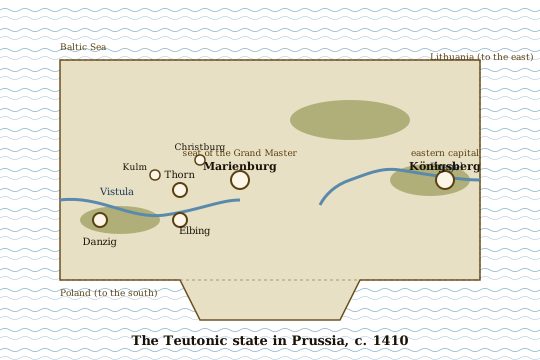
The Teutonic state in Prussia was, for more than three centuries — from the conquest of the Prussian tribes in the 1280s to the secularisation of 1525 — a substantial principality on the south-eastern coast of the Baltic Sea. The state was, by the standards of its time, an unusual political construction: a monastic order bound by the Rule of St Augustine and the three monastic vows, holding sovereign jurisdiction over a multi-ethnic, poly-confessional, increasingly prosperous population of German burghers, native Prussians, Polish-speaking peasants in the south, and a fluctuating population of mercenaries, clerks, and itinerant craftsmen.
The state’s official title was Land und Leute des Deutschen Ordens zu Preussen; its territory stretched, at its greatest extent, from the Vistula in the west to the borders of Lithuania in the east, and from the Baltic littoral in the north to the Polish duchies in the south. The state’s principal seat was, after 1309, the great convent castle of Marienburg on the right bank of the Nogat.
The Geographical Frame
The Teutonic state was bounded by three natural features. To the north lay the Baltic coast, a low-lying shoreline of dunes, lagoons, and brackish estuaries, with few natural harbours. The two great natural harbours of the region — the Vistula mouth at Danzig and the Pregel mouth at Königsberg — were the anchors of the state’s commercial policy. To the east and south the state marched with the grand duchy of Lithuania, a vast, forested, thinly populated territory that, until 1386, was the principal target of the state’s crusading activity. To the south-west the state marched with the duchies of Greater Poland, Kujavia, and Masovia, all of them parts of the Polish crown or of the Piast ducal system. To the west the boundary was, for most of the fourteenth century, the duchy of Pomerania, which the Order acquired in 1309 after a contested purchase from the Margrave of Brandenburg and a brief war.
The interior of the state was a mixture of landscape types. The western portions, around Danzig, Thorn, and Elbing, were rich agricultural land, drained by the Vistula and its tributaries. The central portions, around Marienburg, were lower-lying and well watered. The eastern portions, around Königsberg, were more forested and more sparsely settled. The coast, the long stretch between Danzig and Königsberg known as the Amber Coast, was a zone of small fishing villages and monastic granges.
The Constitutional Order
The state was governed by a constitutional order that has been the subject of extensive scholarly analysis. The supreme magistrate was the Hochmeister (Grand Master), elected for life by the chapter general of the knight-brothers. From 1309 the Grand Master resided at Marienburg. The Grand Master presided over a council of five Grossgebietiger — the Grand Commander, the Grand Marshal, the Grand Hospitaller, the Grand Trapier, and the Grand Chancellor — who were the principal officers of the Order and the heads of the five territorial divisions of the state.
Beneath the central government lay a hierarchy of regional and local officials. The state was divided into Komtureien (commanderies), each under a Komtur (commander) responsible for the administration of justice, the maintenance of the convent castle, the receipt of revenues, the recruitment and quartering of knight-brothers, and the conduct of the small-scale warfare of the Prussian frontier. The Komtureien were grouped into larger regional units, each under one of the five Grossgebietiger. The Grand Commander held the interior of the state (Christburg), the Grand Marshal held the eastern marches (Königsberg), the Grand Hospitaller held the hospitals (Elbing), the Grand Trapier held the wardrobe, and the Grand Chancellor held the chancery and archives.
The native Prussians and the Polish-speaking peasants of the south were, in most cases, not directly ruled by the Order. They were governed through their own local customary law, administered by their own elders and, in the towns, by their own magistrates. The German settlers who came to Prussia in the thirteenth and fourteenth centuries were governed by the Kulm law, a code of urban customary law derived from the older Magdeburg law, which the Order extended to most of the chartered towns.
The Chartered Towns
The chartered towns of the Teutonic state were a striking feature of the political landscape. By the middle of the fourteenth century there were more than a hundred chartered towns in the state, of which more than a dozen — Danzig, Thorn, Elbing, Königsberg, Kulm, Marienburg (the town, distinct from the castle), and others — were of substantial size. The towns were governed by municipal councils (Räte) elected by the patrician burghers. The Order reserved to itself the right to confirm the councils, to hold the high courts, and to collect the customs and the Pfundzoll, a transit duty on the Vistula trade.
The relationship between the Order and the towns was a delicate equilibrium. The Order needed the towns as commercial outlets for the agricultural surplus of the state, as sources of urban taxes, and as the principal recruiting ground for the civic militias that supplemented the Order’s field army. The towns needed the Order for protection against the Lithuanian raids, for access to the Baltic, and for the legal and administrative framework that the Order provided. The relationship was stable for most of the fourteenth century, but it broke down catastrophically in 1454, with the formation of the Prussian Confederation and the beginning of the Thirteen Years’ War.
The Economy of the State
The economy of the Teutonic state rested on three principal pillars: the agricultural production of the demesne and peasant lands, the amber trade of the Baltic coast, and the transit trade of the Hanseatic League. The agricultural production was, by the standards of the time, efficient. The Order introduced the three-field system to much of the state, drained the marshes of the lower Vistula, and encouraged the cultivation of rye, wheat, oats, hops, and flax.
The agricultural surplus was large. The surplus was exported through the great ports of Danzig and Elbing to England, the Netherlands, and the Iberian kingdoms, in a trade that made Danzig one of the great grain ports of the late medieval Baltic. The grain trade was the foundation of the state’s commercial prosperity and the source of a substantial part of the Order’s revenues.
The amber trade was smaller in volume but disproportionately important to the Order’s finances. The Baltic coast of Prussia was the principal European source of amber, and the Order held a strict monopoly on its collection, processing, and export. The amber trade was difficult to police, and the smuggling of amber was a constant concern of the Order’s customs administration.
The Golden Age
The period from roughly 1309 — when the Grand Master moved his seat from Venice to Marienburg — to the death of Grand Master Winrich von Kniprode in 1382 is the golden age of the Teutonic state. The great castles of Marienburg, Königsberg, Lochstedt, and others were built or rebuilt in brick; the chancery produced some of the most elegant diplomatic documents of the period; the Order’s field army won substantial victories against the Lithuanians; and the population of the state grew steadily through German immigration and the natural increase of the indigenous population.
The golden age was not, of course, without strain. The conversion of Lithuania in 1386 removed the principal strategic rationale for the Order’s continuing existence. The accession of the Jagiellonian dynasty to the Polish throne in 1386 created a powerful and aggressive neighbour. The Order’s attempts to reform its constitutional structure in the late fourteenth century were frustrated by the resistance of the knight-brothers. The financial cost of the great castles was substantial. And the long Lithuanian campaign had produced a class of veterans who were not always easily re-employed in a state that no longer needed a large field army.
The Long Decline
The decline of the Teutonic state began, in most accounts, with the defeat at Grunwald in 1410. The battle itself did not destroy the state; the Order retained its territories and rebuilt its army. But the political shock of the defeat was profound. The Order’s prestige in the Latin West was reduced; the Order’s ability to recruit knight-brothers from the western German lands was impaired; the Order’s diplomatic position in the Baltic was weakened; and the Polish-Lithuanian union was confirmed as the dominant power of the region.
The fifteenth century was a century of slow economic and demographic decline. The grain trade through Danzig continued to flourish, but the Order’s share of the customs revenue fell as the patrician class of the towns grew richer and more assertive. The Order’s attempts to monopolise the grain trade, particularly through the Pfundzoll and the Kornkäppel, provoked the opposition of the very towns that produced the Order’s revenue. The Order’s attempts to discipline the towns led directly to the formation of the Prussian Confederation in 1440 and to the outbreak of the Thirteen Years’ War in 1454.
The Thirteen Years’ War
The Thirteen Years’ War, fought between the Teutonic Order and the Polish-Lithuanian union from 1454 to 1466, was the most destructive conflict in the history of the Teutonic state. The war was, in essence, a civil war: it was fought, in part, between the Order and the Prussian towns and gentry, and it was, in part, between the Order and the Polish-Lithuanian union, which intervened on behalf of the Prussian rebels.
The war was a disaster for the Order. The Order’s field army, although it won several notable engagements, was unable to suppress the Confederation; the Order’s finances, already strained by the costs of the Lithuanian campaigns, were exhausted by the costs of the war; the Order’s diplomatic position in the Empire was undermined by the perception that the Order was fighting a hopeless war against an unjust cause. The war was concluded, in 1466, by the Second Peace of Thorn, by which the Order ceded western Prussia — Danzig, Thorn, Elbing, Marienburg — to the Polish crown and accepted the Polish crown’s overlordship of the eastern part of its territories.
The Secularisation of 1525
The end of the Teutonic state came in 1525, when Grand Master Albert of Brandenburg-Ansbach dissolved the Order in Prussia and converted the territories into a secular duchy, the duchy of Prussia, to be held as a Polish fief in Albert’s own family. The duchy of Prussia was, in the following centuries, the basis of the Brandenburg-Prussian state that would dominate north-eastern Europe until the twentieth century. The Order’s corporate history in Prussia was, with the Treaty of Kraków of 1525, formally ended.
The Order survived, in the German and Habsburg lands, as a small ecclesiastical body. The Order’s master in Livonia, Wolter von Plettenberg, repudiated Albert’s action and continued to govern the Livonian territories in the name of the Order, but the Order’s effective presence in the Baltic region was, in this period, reduced to the Livonian branch and a handful of German commanderies. The Order’s headquarters moved, by way of Königsberg, Danzig, and various intermediate residences, to Vienna, where it has remained to the present day.
The Long Shadow
The Teutonic state has cast a long shadow over the history of north-eastern Europe. The Hohenzollern duchy of Prussia that was created in 1525 became, in time, the Kingdom of Prussia and the German Empire. The territorial losses of the Order to Poland in 1466 created the political basis for the Free City of Danzig and the Polish Corridor. The Order’s constitutional traditions shaped the constitutional traditions of the German states that succeeded it. The Order’s convent castles are still standing in more than a hundred sites. The Order’s brick Gothic architecture shaped the architectural vocabulary of the region for centuries. The Order’s heraldic symbols, particularly the black cross on the white field, are still in use as the symbol of the modern German federal state of Baden-Württemberg and as the symbol of several modern Polish and Baltic military units.
The Teutonic state is, in short, one of the foundational institutions of the modern Baltic region, and the history of the state is the history of a great experiment in monastic sovereignty, in colonial settlement, and in the long interaction of German, Prussian, Polish, Lithuanian, and Livonian societies.
Related Reading
For the establishment of the state, see the article on the Prussian Crusade and the Treaty of Kalisz of 1343. For the golden age, see the reign of Winrich von Kniprode and the construction of Marienburg. For the commercial basis of the state, see the economy and trade section, and for the long collapse, see the Thirteen Years’ War.
Sources
- Biskup, Marian, and Gerard Labuda. Dzieje zakonu krzyżackiego w Prusach. Gdańsk: Wydawnictwo Morskie, 1986.
- Boockmann, Hartmut. Der Deutsche Orden: Zwölf Kapitel aus seiner Geschichte. Munich: Beck, 1981.
- Biskup, Marian. Der Deutsche Orden im Zeitalter der Reformation. Marburg: Elwert, 1989.
- Töppen, Max, ed. Acten der Ständetage Preussens unter der Herrschaft des Deutschen Ordens. 5 vols. Leipzig: Duncker & Humblot, 1867–1886.
- Urban, William. The Teutonic Knights: A Military History. London: Greenhill, 2003.