The Black Cross of the Teutonic Order
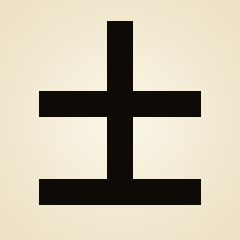
The black cross on a white field is the principal emblem of the Teutonic Order, and the black cross has been the badge of the Order since the early years of the Order’s existence. The black cross is a Latin cross, with the vertical arm longer than the horizontal arms, embroidered in black on a white background. The cross is worn on the left shoulder of the white habit of the brethren, and the cross is also the principal element of the Order’s banner, the Order’s seal, and the Order’s heraldic arms. The black cross has remained recognisable, in essentially the same form, for more than eight centuries.
For the broader context of the Order’s visual identity, see the article on the symbols, habit, and heraldry of the Order. For the Grand Master’s coat of arms, which incorporates the black cross, see the related article on the Grand Master’s coat of arms. For the white habit on which the cross is worn, see the article on the daily rules of the Order and the article on becoming a Teutonic knight.
The Origins of the Black Cross
The origins of the black cross are not entirely clear, but the most plausible account is that the cross was adopted after 1198, when the fraternity at Acre was placed under the Rule of St Augustine by the papacy. The fraternity had, until that point, used a number of emblems of a more or less ad hoc character, and the placement of the fraternity under the Rule of St Augustine required the adoption of a more formal emblem.
The choice of the black cross was, in the customary interpretation, a deliberate echo of the cross of the Latin Kingdom of Jerusalem, and an expression of the fraternity’s loyalty to the Latin cause in the Holy Land. The black cross was also a deliberate echo of the crosses of the other military orders: the white cross of the Hospitallers, the red cross of the Templars. The black cross was, in this sense, the third of the three principal crosses of the crusading orders, and the black cross was, a central element of the visual culture of the Latin Kingdom of Jerusalem.
The Form of the Black Cross
The black cross is a Latin cross, with the vertical arm longer than the horizontal arms, embroidered in black on a white background. The form of the cross has varied over the centuries, and the historians of the Order have identified several distinct variants. The earliest form, of the late twelfth and early thirteenth centuries, was a simple Latin cross, with the vertical arm only slightly longer than the horizontal arms, embroidered in black on a white linen or woollen background, and attached to the left shoulder of the white habit by a small clasp or by a stitch.
A later form, which became standard in the late medieval period, was a cross with a slightly broader vertical arm, embroidered in black silk on a white linen or woollen background. A still later form, which became standard in the early modern period, was the so-called Kreuz mit dem Langen Schaft, in which the vertical arm extends well below the horizontal arms, and which is the form in which the Teutonic cross is most commonly recognised in the modern heraldic and ceremonial practice of the Order.
The Symbolism of the Black Cross
The black cross has been the subject of substantial symbolic interpretation over the centuries. The black colour has been interpreted as a symbol of the gravity of the religious vocation, of the penitential character of the monastic life, and of the constant sense of mortality that the brethren were expected to maintain. The white background has been interpreted as a symbol of the purity of the religious life, of the chastity of the brethren, and of the luminous character of the divine grace that the brethren professed to serve. The cross itself has been interpreted as a symbol of the central mystery of the Christian faith, of the redemptive sacrifice of Christ, and of the brethren’s commitment to the imitation of Christ in their own lives.
The symbolic interpretation of the black cross was, in the Middle Ages, a central element of the Order’s religious self-understanding. The brethren were instructed, in the customary formation, in the symbolic interpretation of the cross, and were expected to maintain a constant sense of the symbolic significance of the cross in their daily life.
The Use of the Black Cross in the Order
The black cross was used in a wide range of contexts in the Order’s internal and external practice. The cross was worn on the left shoulder of the white habit of the knight-brothers and the priestly brothers, in the chapel, in the refectory, in the dormitory, and in the field, and was the principal element of the Order’s military appearance on the field of battle.
The cross was also used on the Order’s banner. The principal banner, the Grossbanner, was a great square banner of white silk, embroidered with the black cross. The cross was also used on the Order’s seal — the seal of the Grand Master, the seals of the five Grossgebietiger, the seals of the regional Komture, and the seals of the lesser officials all incorporated the black cross — and on the Order’s official documents, regalia, monuments, and tombstones.
The Modern Use of the Black Cross
The black cross has remained, in essentially the same form, the principal emblem of the Teutonic Order to the present day. The Catholic branch of the Teutonic Order, now a clerical institution dedicated to charitable work in the German-speaking world, has continued to use the black cross as its principal emblem. The black cross on a white field is the basis of the national flag of Baden-Württemberg, and is a feature of the heraldic arms of a number of German and Austrian cities that were once under the protection of the Order, and of the modern civic heraldry of the Polish, Lithuanian, Latvian, and Estonian cities that were once part of the Order’s possessions.
Sources
- Boockmann, Hartmut. Der Deutsche Orden: Zwölf Kapitel aus seiner Geschichte. Munich: Beck, 1981.
- Feldmann, Hans-Joachim. Der Deutschordensritter: Gestalten, Geschichte, Geisteswelt. Heiligenberg: Hinderer, 1984.
- Rohde, Hans. Macht und Pracht der Marienburg. Königstein: Langewiesche, 1952.
Related Reading
For the broader context of the Order’s visual identity, see the article on the symbols, habit, and heraldry of the Order and the parent pillar on the structure and daily life of the Order. For the Grand Master’s coat of arms, which incorporates the black cross, see the related article on the Grand Master’s coat of arms. For the white habit on which the cross is worn, see the article on becoming a Teutonic knight and the article on the daily rules of the Order. For the founding context of the cross, see the article on the founding of the Order at Acre. For the constitutional context, see the article on the hierarchy of the Order.