The Grand Master’s Coat of Arms of the Teutonic Order
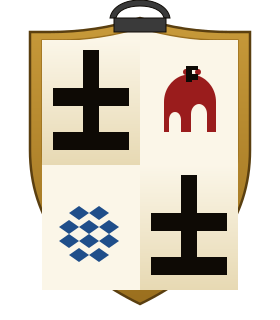
The Grand Master of the Teutonic Order was entitled, in the heraldic practice of the Order, to a distinctive coat of arms. The Grand Master’s arms were a combination of the black cross of the Order and the personal arms of the Grand Master’s own family, impaled or quartered according to the customary rules of the heraldic tradition. The Grand Master’s arms were displayed on the seals of the Grand Master, on the banners of the Grand Master, on the official robes of the Grand Master, and on the principal monuments of the Order’s headquarters at the Marienburg in Prussia.
For the broader context of the Order’s visual identity, see the article on the symbols, habit, and heraldry of the Order. For the principal emblem of the Order that is incorporated into the Grand Master’s arms, see the related article on the black cross of the Order. For the constitutional position of the Grand Master, see the article on the hierarchy of the Order and the article on the election of the Grand Master.
The Elements of the Grand Master’s Arms
The Grand Master’s coat of arms, in its full form, was a quartered shield, in which the first and fourth quarters displayed the black cross of the Order on a white field — sometimes called the Teutonic quarter — and the second and third quarters displayed the personal arms of the Grand Master’s own family. The arms were, in many cases, accompanied by the customary heraldic devices: a helm, a crest, a mantle, supporters, and a motto.
The Teutonic quarter was, under the heraldic practice, the principal element of the Grand Master’s arms, and the Teutonic quarter was, the most distinctive element of the Grand Master’s arms. The form of the cross in the Teutonic quarter varied over the centuries, and the form of the cross followed the same general pattern as the form of the cross worn on the white habit of the brethren. The personal arms of the Grand Master’s family were, under the heraldic practice, the arms of the Grand Master in his personal capacity, and were, in many cases, the arms of one of the great aristocratic or ministerial families of the German lands.
The Development of the Grand Master’s Arms
The form of the Grand Master’s arms developed over the centuries. The early Grand Masters, from the late twelfth century until the middle of the thirteenth century, used a simple black cross on a white field, with the personal arms of the Grand Master displayed on a separate shield. The separation of the Order’s arms and the personal arms was, a simple heraldic arrangement, and was, in many cases, sufficient for the practical purposes of the early Grand Masters.
By the late thirteenth century, the Grand Master’s arms had been formalised into a quartered shield, in which the first and fourth quarters displayed the black cross of the Order, and the second and third quarters displayed the personal arms of the Grand Master’s own family. The quartered shield was, an important innovation of the Order’s heraldic practice, and was, in many cases, the prototype for the coats of arms of the other principal officials of the Order. The Grand Master’s arms were further developed, by the late Middle Ages, by the addition of the customary heraldic devices: the helm, the crest, the mantle, the supporters, and the motto.
The Grand Master’s Mitre
The Grand Master was entitled to wear a mitre modelled on those of the bishops. The Grand Master’s mitre was a substantial piece of ceremonial regalia, embroidered with the Grand Master’s arms and adorned with the customary liturgical symbols. The Grand Master’s mitre was, in the constitutional theory of the Order, a courtesy rather than a jurisdiction: the Grand Master was, in the strict canonical sense, not a bishop, and did not exercise the jurisdiction of a bishop.
The Grand Master’s mitre was, however, a substantial ceremonial honour, and was, a central element of the Grand Master’s public identity. The mitre was, in many cases, embroidered with the black cross of the Order, with the personal arms of the Grand Master’s own family, and with the customary liturgical symbols. The mitre was, in many cases, adorned with gold thread, with silver thread, with precious stones, and with pearls, and was, a substantial work of medieval goldsmith’s art.
The Grand Master’s Seals
The Grand Master’s seal was a large oval seal, displaying the Grand Master’s arms and surrounded by an inscription in Latin giving the Grand Master’s name and title. The seal of the Grand Master was used for the most solemn documents of the Order: treaties, capitulations, papal bulls, and so on. The seal of the Grand Master was, in the Middle Ages, an instrument of substantial diplomatic weight, and the surviving examples are an important primary source for the diplomatic history of the Order.
The Grand Master’s seal was, in many cases, a substantial work of medieval sigillographic art, cut by the leading seal-cutters of the Order’s principal cities. The seal was, in many cases, accompanied by a counter-seal, displaying the Grand Master’s personal arms. The seal was kept in the chancery of the Order, under the custody of the Grand Chancellor, and was an essential element of the Grand Master’s official documents.
The arms of the Grand Master were used on the seals, banners, official robes, and principal monuments of the Order’s headquarters, on the tombstones of the deceased Grand Masters, and on the various other objects that the Order produced or commissioned, and were a central element of the Grand Master’s public identity and of the Order’s public presence in the medieval Latin world.
Sources
- Boockmann, Hartmut. Der Deutsche Orden: Zwölf Kapitel aus seiner Geschichte. Munich: Beck, 1981.
- Feldmann, Hans-Joachim. Der Deutschordensritter: Gestalten, Geschichte, Geisteswelt. Heiligenberg: Hinderer, 1984.
- Rohde, Hans. Macht und Pracht der Marienburg. Königstein: Langewiesche, 1952.
Related Reading
For the broader context of the Order’s visual identity, see the article on the symbols, habit, and heraldry of the Order and the parent pillar on the structure and daily life of the Order. For the black cross that is incorporated into the Grand Master’s arms, see the related article on the black cross of the Order. For the constitutional position of the Grand Master, see the article on the hierarchy of the Order and the article on the election of the Grand Master. For the five principal officers, see the article on the five Grossgebietiger. For the building on which the arms were displayed, see the pillar on the Teutonic state in Prussia. For the founding context of the symbols, see the article on the founding of the Order at Acre.